
Menopause and Perimenopause Care in Aurora, Ontario
Most women arrive here having already been told their bloodwork is normal. Being told nothing is wrong does not make the symptoms less real.
Am I in Perimenopause or Menopause?
Perimenopause is often mistaken for stress, burnout, thyroid disease, or simply aging. It can begin up to a decade before your final period, and it rarely announces itself clearly.
Menopause itself is only diagnosed looking backward, after twelve consecutive months without a period, which means waiting for the label often means waiting a year while you are struggling.
You do not need a diagnosis to be assessed and treated.
If any of these sound familiar, your hormones are worth investigating:
Cycle changes
brain fog
weight gain
hot flashes & night sweats
Sleep disturbances
mood, anxiety & low libido
Your cycles can still be fairly regular and still be in perimenopause.
Symptoms often begin years before you see cycle changes, which is why so many women are told to watch and wait.
What is Actually Happening to your Hormones
Most hormone care asks what is low. We ask why.
Perimenopause is not a switch that flips. It is a transition, and it is rarely orderly. Estrogen does not simply decline. It fluctuates and often swings higher than it ever did in your reproductive years before it falls.
Progesterone tends to drop earlier and more steadily as ovulation becomes less reliable. That mismatch is why so many women feel anxious, sleepless and irritable while their blood work still reads as normal.
We use the STRAW staging system (Stages of Reproductive Aging Workshop), the framework used in menopause medicine internationally, to place you accurately in the transition based on your cycle history and symptoms, alongside your labs, rather than a single number in isolation.
Hormones Don't Work in Isolation
Thyroid
Fatigue, weight gain, hair thinning and brain fog could be your thyroid. They could be your estrogen. Frequently they are both, because falling estrogen changes how your body handles thyroid hormone.
We run a full panel, not just TSH. We include free T3, free T4 and antibodies.
Cortisol and the stress response
The perimenopausal brain is more reactive to cortisol, which is part of why sleep and anxiety worsen now, even when nothing in your life has changed.
Stress and hormones are not separate problems. We assess them together.
Insulin and metabolism
If hormone therapy is appropriate, we discuss the options, the evidence, and the risks and benefits in the context of your own health history and what you can reasonably expect. If something else is driving your symptoms, we tell you that and we treat what is actually there and the root cause.
Dhea, testosterone and the adrenals
Often overlooked, and often relevant to energy, libido, mood and muscle. Testosterone declines quietly for years, and it is rarely investigated properly in women.
We assess the system, not only the symptom.
Hormone Therapy
Estrogen, progesterone and where appropriate, testosterone. Multiple routes and forms, chosen to fit your history and your preference.
Metabolic and weight
The abdominal weight gain of perimenopause is driven by insulin resistance, not effort. We address it as the metabolic problem it is.
sleep
Sleep is often the first thing to break and the thing that makes everything else worse. It gets treated as a priority, not an afterthought.
bone health
Bone loss accelerates sharply in the years around your final period, and it is silent. We screen and we act early, not after a fracture.
Cardiovascular & longevity
Cardiovascular risk climbs after menopause. This is the window where prevention actually changes the trajectory. We look at ApoB, Lp(a), insulin and inflammation, not just standard cholesterol.
Not every woman needs hormones. Every woman deserves the full conversation.
care from a nurse practitioner who knows your full story
Partner with us on your journey to optimal wellness.
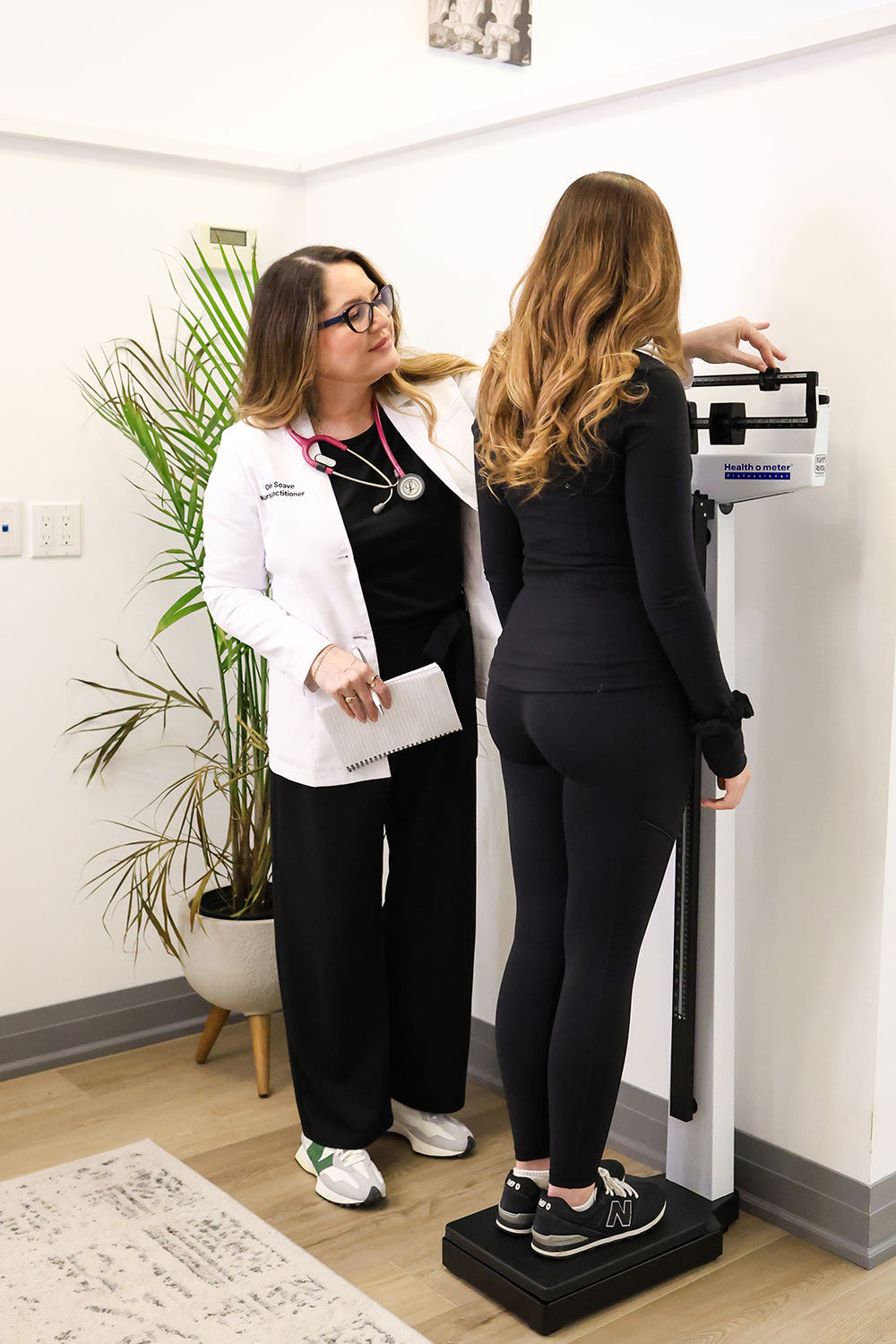
NOW Health Clinic is led by Olivia Soave, PHC-NP, MN, RN(EC), Owner and Medical Director. Olivia is a Primary Health Care Nurse Practitioner with a full primary care scope and advanced training in bioidentical hormone replacement therapy, functional medicine, and longevity medicine.
Every hormone assessment at NOW Health follows the same standard: a full history, comprehensive testing, and a plan built around you. Hormones are never looked at in isolation.
Book a consultation
New patients are welcome and no referral is required. Care begins with a Meet & Greet so we can understand what you are looking for and ensure we are the right fit for you. From there, bloodwork, and then a dedicated appointment for your full initial comprehensive consultation, where we go through your results together and build your plan.
Appointments are available in person or virtually. Our clinic is at 220 Industrial Parkway South, Unit 40, Aurora, Ontario. We see patients virtually from across the province.
Frequently Asked Questions
Am I too young for perimenopause?
Probably not. Perimenopause commonly begins in the early to mid-forties, and it can begin in the late thirties. The average age of menopause in Canada is around 51, and the transition leading up to it often lasts several years. If you are in your late thirties, it is worth investigating rather than waiting.
Am I too old to start hormone therapy?
Not necessarily. The decision depends on how far you are from your final period, your symptoms, and your individual risk profile, not on your age alone. Starting within roughly ten years of menopause is generally considered the most favourable window, but that is a guideline, not a cutoff. It is a conversation, not a door that closes on a birthday.
Is hormone therapy safe after 60?
It can be, but the calculus changes. The further you are from your final period, the more carefully we weigh cardiovascular and clotting risk against your symptoms and your quality of life. Route matters here: transdermal estrogen carries a different risk profile than oral. This is a conversation to have with a provider who knows your full history, not a question with a single answer.
Can I do this if I have a history of breast cancer?
The answer depends on your cancer, including receptor status, and any decision belongs with you and your oncology team. That does not mean there is nothing we can do. There are non hormonal options for hot flashes, sleep and mood, local therapy for vaginal symptoms, and the metabolic, bone and cardiovascular work that matters just as much after cancer treatment. If hormone therapy is something you want to explore, it is an individualized conversation, and we are willing to have it.
Do I need to stop my birth control first?
Not necessarily, and please do not stop it on your own. Hormonal contraception can mask perimenopausal symptoms and will affect how we interpret your bloodwork, so it is part of the conversation from the first visit. For some women, staying on it is the right choice for now. For others, we plan a transition. Either way, it is a decision we make together, not something to sort out before you book.
My doctor said my bloodwork is normal. Why do I still feel this way?
Because “normal” is a wide range, and a single hormone level drawn on one day of a fluctuating cycle can look unremarkable while you are in the middle of significant change. Many women are also told that because they are still menstruating, everything must be fine. That is not true. Perimenopause frequently begins while cycles are still regular, and symptoms can start years before your final period.
Conventional reference ranges are built to catch disease, not to define optimal function. We interpret your results against both, and we read them alongside your symptoms and your cycle history rather than in isolation.
.
Do I need a referral?
No. A nurse practitioner in Ontario can see you directly. Book a Meet and Greet and we go from there.
Is this covered by OHIP??
Consultations are not covered by OHIP. Some bloodwork and diagnostic testing is. Some private insurance plans cover practitioner visits under a Health Spending Account, so it is worth checking your plan.
Can I be seen virtually?
Yes. We see patients in person in Aurora and virtually from across Ontario. Bloodwork is arranged near you.
How long before I feel a difference?
It varies by symptom. Sleep and hot flashes often respond within weeks. Mood, energy and cognitive symptoms typically take longer. Metabolic and body composition changes are the slowest. We usually repeat labs at around twelve weeks and adjust from there, so the first few months are a process of tuning rather than a single fix.
Do I have to be menopausal to be seen here?
No. Many of the women we see are in perimenopause, still cycling, and often years from their final period. Some are younger women, premenopausal and simply feel off, without knowing why, and want answers. Some are postmenopausal and want to address bone, metabolic and cardiovascular risk. We see anyone experiencing symptoms of hormonal transition, at any stage.
Contact
220 Industrial Pkwy S. Unit 40, Aurora, ON L4G 3V6
Follow
Website by Web of Words
© 2024 Now Health Clinic